Introduction
In the evolving world of education, From Lab to Life: How AFCS Yola Brings Science into Everyday Learning is no longer a lofty ideal — it is a guiding principle. At AFCS Yola, we believe deeply in this approach, which means that science is not confined to textbooks or lab coats; it spills over into daily experience. This blog post explores how AFCS Yola brings science into everyday learning through dynamic lab work, inspiring science fairs, and real-life applications of classroom experiments. Join us on a journey through microscopes, project halls, and community impact as we highlight how AFCS Yola Science in Everyday Learning transcends the classroom walls.
Table of Contents
- Introduction
- The Philosophy Behind AFCS Yola Science in Everyday Learning
- Laboratory Work as a Core Pillar
- Designing Purposeful Experiments
- Safety, Protocol, and Scientific Thinking
- Integration Across Subjects
- Science Fairs: Showcasing Inquiry and Innovation
- Planning & Preparation
- Student Projects: Themes and Examples
- Judging, Exhibition, and Community Engagement
- Real-Life Applications of Classroom Experiments
- Biology Beyond the Text: Biodiversity, Botany & Ecology
- Chemistry in the Kitchen, Environment, and Health
- Physics: Mechanics, Electricity, and Everyday Gadgets
- Environmental & Earth Science Projects
- Student Stories & Impact
- Teacher Development & Laboratory Infrastructure
- Challenges, Lessons Learned, and Continuous Improvement
- Future Directions: Scaling AFCS Yola Science in Everyday Learning
- Conclusion
1. Introduction
AFCS Yola Science in Everyday Learning begins with a simple conviction: science belongs to all of us. When students see the glass of water they drink, the plants in the school compound, or the sunlight streaming through the windows as opportunities for inquiry, learning becomes alive. At AFCS Yola, we are committed to blurring the line between “laboratory science” and lived experience — to take “from lab to life” as a working mantra.
In this post, we will walk you through how this philosophy manifests: through structured laboratory work, vibrant science fairs, and experiments whose implications reach beyond the school grounds. Along the way, we will reflect on successes, challenges, and the future of bringing AFCS Yola Science in Everyday Learning to every student.
2. The Philosophy Behind AFCS Yola Science in Everyday Learning
Why science belongs everywhere
Many schools treat science as an isolated subject — something you do during a class period, often with glassware, charts, or experiments tucked away in a lab. But at AFCS Yola, the philosophy is different: science is a lens, a habit of mind, a way to observe, question, and experiment in everyday settings.
When students internalize that scientific thinking applies to the world around them — whether monitoring water quality in the school pond, measuring sunlight angles on rooftops, or testing soil pH in garden beds — their curiosity deepens. AFCS Yola Science in Everyday Learning is rooted in giving learners that bridge from textbook to lived context.
Goals of AFCS Yola Science in Everyday Learning
- Critical thinking & inquiry skills: Students learn not just to memorize facts but to ask questions, plan investigations, collect data, and draw evidence-based conclusions.
- Ownership of learning: When students initiate or adapt experiments tied to their interests or surroundings, they become co-creators of knowledge.
- Relevance & motivation: Connecting science to agriculture, health, environment, or technology in the local context helps students see value in their studies.
- Community engagement: Projects may involve local water testing, waste management, or sustainable energy at the school or in local homes, forging ties with neighbors.
- Sustainability of infrastructure: Ensuring labs, supplies, and teacher training are integral parts of school systems so the practice is not a one-off.
With these goals in mind, let us explore how lab work, science fairs, and real-life applications are organized and implemented at AFCS Yola.
3. Laboratory Work as a Core Pillar
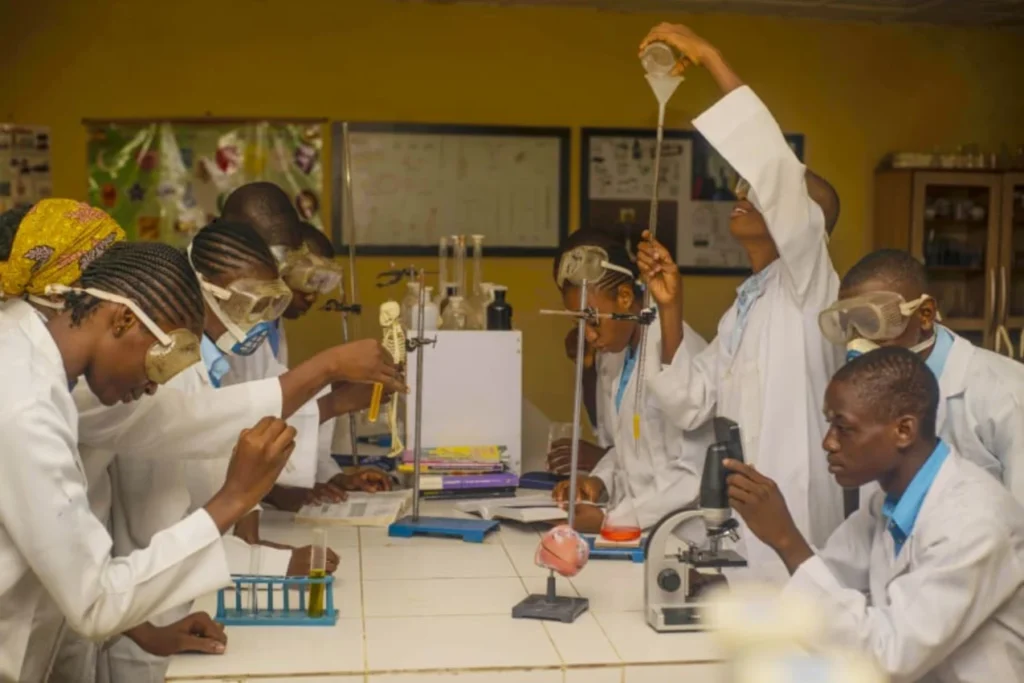
At the heart of AFCS Yola Science in Everyday Learning is the belief that hands-on experiments in a well-equipped lab environment anchor student learning. A laboratory is not a showpiece — it is a working engine of student inquiry.
3.1 Designing Purposeful Experiments
To make lab work meaningful, experiments are chosen or adapted to:
- Illustrate or deepen core scientific concepts (e.g. osmosis, enzyme activity, circuits).
- Be modifiable or extendable by students (they can vary parameters).
- Use locally available materials (so students can replicate at home or in their environment).
- Tie into larger student or community questions (e.g. water quality, plant growth, renewable energy).
Example: Investigating Water pH and Plant Growth
Instead of teaching just that “soil pH affects nutrient availability,” students may design an experiment to grow seedlings in soils or water adjusted to different pH values, tracking growth rates, leaf color, and root development. Later, they may apply this knowledge to garden beds around the school or local farms.
When designing these experiments, teachers scaffold them: provide a template, guide initial steps, but allow student autonomy in deciding variables, replication, and data collection methods.
3.2 Safety, Protocol, and Scientific Thinking
To ensure that the lab is a safe and productive space, AFCS Yola has instituted:
- Safety training and culture: All students must complete a safety orientation. Then, in each lab session, safety rules (e.g. handling chemicals, glassware, PPE usage) are revisited.
- Standard operating procedures (SOPs): Clear, step-by-step protocols for common lab methods (e.g. titrations, pipetting, sterilization).
- Lab notebooks: Students maintain lab notebooks with date, objective, materials, methods, observations, and reflections.
- Hypothesis development & variable reasoning: Before experimenting, students propose hypotheses and predict outcomes. After experiments, they reflect on the results, sources of error, and possible improvements.
- Replication & controls: Emphasizing the need for controls and multiple trials so that data is robust, not anecdotal.
This approach ensures that lab work is not random or risky, but a structured expression of scientific reasoning.
3.3 Integration Across Subjects
Science does not stand alone. AFCS Yola Science in Everyday Learning seeks to integrate science labs with mathematics, technology, language arts, and even social studies.
- Mathematics: Students analyze data (mean, standard deviation, graphing, trend lines).
- ICT / Technology: Use of data loggers, sensors, spreadsheets, and even smartphone-based measurement apps (e.g. light intensity, accelerometers).
- Language Arts: Students write lab reports, peer reviews, or blog their experiment process. They present to peers and community members.
- Social Studies / Geography: A project on soil erosion might connect to local land use practices or climate.
By weaving science with other subjects, students see it as part of their holistic education, not a silo.
4. Science Fairs: Showcasing Inquiry and Innovation
One of the signature features of AFCS Yola Science in Everyday Learning is our annual science fair — a celebratory stage where students present their experiments, prototypes, and investigations to peers, parents, and the community.
4.1 Planning & Preparation
Early Timeline & Milestones
Science fair planning begins months ahead. A rough schedule may look like:
| Time | Activity |
|---|---|
| 3 months out | Theme selection, student idea submissions, initial mentoring |
| 2 months out | Project proposal drafting, materials procurement, risk review |
| 1 month out | Pilot runs, data collection, iteration |
| 2 weeks out | Final experiment runs, display design, rehearsals |
| Fair day | Presentation, judging, exhibition to community |
Selecting Themes and Areas
Themes may rotate each year (e.g. Sustainable Futures, Health & Environment, Energy Innovations). Within a theme, students may submit proposals. Teachers and mentors help refine ideas, check feasibility, and align with curriculum goals.
Mentorship & Peer Review
Students meet regularly with teacher mentors or senior students who guide them on experiment design, data collection, and troubleshooting. There may also be a peer review session where teams present mock proposals and receive feedback.
4.2 Student Projects: Themes and Examples
Below are sample project themes and narrative descriptions seen at AFCS Yola fairs:
- “Clean Water for All”: Students design low-cost filtration systems using activated charcoal, sand, and locally sourced materials. They test before/after turbidity, microbial content, or pH.
- “Solar-Powered LED Lighting”: Using small solar panels, students build a circuit to power LED bulbs, measure efficiency under different light intensities or panel orientations, and propose designs for rural lighting.
- “Composting Bioreactors”: Students compare composting in sealed vs. ventilated bins, measure temperature, mass loss, and nutrient analysis of final compost.
- “Germination and Soil Types”: Different soils (sandy, loamy, clay) tested for water retention and seed germination rates.
- “Air Quality Monitoring”: Using simple sensors or chemical strips to test particulate matter or CO₂ levels at different school locations (e.g. near road, under trees) and analyzing temporal variation.
Students typically accompany their experiments with display posters, digital slideshows, or models, and present findings to judges and visitors.
4.3 Judging, Exhibition, and Community Engagement
Judging Criteria
Judges evaluate based on:
- Clarity of objectives and hypothesis
- Experimental design, controls, and replication
- Quality and analysis of data
- Depth of student reflection on errors, improvements
- Practical relevance and innovation
- Presentation, clarity, and ability to answer questions
Exhibition & Visitor Engagement
On fair day, parents, local dignitaries, and community members are invited. Students rotate through exhibition booths, explaining their work to visitors. Some fairs include poster walks, live demonstrations, and mini-science shows.
Awards & Recognition
While prizes are given (e.g. best innovation, best display, community relevance), emphasis is also placed on recognition: certificates, blog features, publishing on school website, or funding for further development.
Community Linkages
Projects often extend beyond the fair. For instance, a winning water filtration model might be piloted in a neighboring community or primary school. Local agricultural extension services or NGOs might collaborate to scale promising prototypes. This bridges the fair from showcase to real-world impact.
5. Real-Life Applications of Classroom Experiments
To truly embody AFCS Yola Science in Everyday Learning, experiments conducted in class must have real-life relevance. Below are thematic bridges between classroom experiments and community or individual impact.
5.1 Biology Beyond the Text: Biodiversity, Botany & Ecology
School Garden & Plant Trials
Experiments done in the lab—varying fertilizer amounts, soil pH, watering regimes—can be transferred to garden plots. Students measure growth, yield, pest incidence, or nutritional content of vegetables or herbs. This reinforces the idea that biological science is not abstract; it feeds into food security and health.
Biodiversity Surveys
Students use quadrats or transect lines to survey insects, plants, or microbial diversity around school premises. They might compare shaded vs. sunlit zones, disturbed vs. undisturbed soil, or seasonally. The data help monitor environmental changes or local species presence.
Microbiology & Waste Management
Students may culture microorganisms from soil, compost, or water samples to study decomposition or pollutant degradation. For instance, isolating bacteria that degrade oil or test antibiotic resistance. In partnership with the school’s waste management plan, microbial experiments can inform composting or waste breakdown strategies.
Animal Studies & Behavior
With care and ethics, students may observe model organisms (e.g. insects, small aquatic organisms) under varying conditions: light, temperature, or chemicals. The results feed into discussions on ecology, adaptation, or environmental stress.
5.2 Chemistry in the Kitchen, Environment, and Health
pH & Acidity Tests in Foods
Students measure acidity (pH) of common beverages or foods (tomato juice, soft drinks, rainwater) using indicators or pH meters. They might then explore neutralization reactions—how adding baking soda or bases affects acidity—and relate to digestive health or food preservation.
Water Quality & Contaminant Testing
Laboratory methods taught (titration, indicator tests, spectrophotometry) are applied to local water sources: boreholes, wells, streams. Students test for hardness, nitrates, nitrites, heavy metals, or dissolved oxygen. The findings may inform community health or school water use.
Corrosion & Metal Protection
Students expose metal samples (iron nails, copper wires) to various treatments (coatings, salts, inhibitors) and track rusting over time. The data can help inform maintenance of school fences or plumbing.
Soap & Detergent Chemistry
Using fats and alkali, students synthesize simple soaps or test the cleaning efficiency of different detergents (hard vs soft water, concentration vs stain removal). This project connects classroom chemistry to everyday household needs.
Photochemistry & Dyes
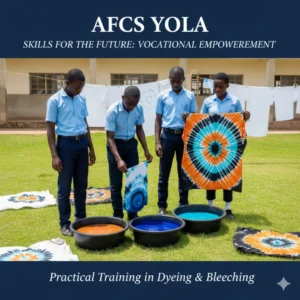
Students may experiment with natural dyes from plants and test bleaching, color fastness, or reaction under light exposure — useful for art, fabric coloring, or sustainable alternatives to synthetic dyes.
5.3 Physics: Mechanics, Electricity, and Everyday Gadgets
Simple Machines & Mechanical Advantage
Using levers, pulleys, inclined planes, and other apparatus, students test mechanical advantage under varying loads or friction. They then apply findings to school facilities: for instance, designing a pulley system for flagpoles, water pumps, or lifting tasks.
Electric Circuits & Renewable Energy
Experiments with circuits (resistors, capacitors, LED, switches) flow into larger projects: solar chargers, small wind turbines, or energy monitoring. A student project might design a mini solar street lamp for the school compound, measure battery discharge curves, or examine orientation of panels for maximum yield.
Oscillations & Waves
Using pendulums or wave tanks, students examine periods, damping, resonance. They may relate the findings to real systems: seismic waves, musical instruments, or mechanical vibrations in buildings.
Thermodynamics & Heat Transfer
Classroom experiments on conduction, convection, and radiation (e.g. with metal rods, water baths, insulation materials) can inform practical decisions: insulating school buildings, designing cooling systems, or selecting cooking utensils.
Optics & Light
Experiments with lenses, prisms, reflection/refraction can connect to real-life contexts: designing simple magnifiers, testing water clarity, refractive indices, or even modeling how microscopes/cameras work.
5.4 Environmental & Earth Science Projects
Soil Erosion & Conservation
Using miniature slope models or runoff flumes, students simulate erosion under different land cover (bare soil, grass, mulch). The results feed into school yard planning or reforestation efforts.
Hydrology & Rainfall Capture
Students may build rain gauges, water collection systems, or measure runoff and infiltration in different surfaces (paved, grass, gravel). Findings can inform school drainage design, water harvesting, or garden irrigation.
Air Quality & Pollution Monitoring
As earlier indicated, students test for particulate matter, gaseous pollutants, or CO₂ under different conditions (rush hour, tree shade, near roads). These data may lead to advocacy or planting vegetation barriers.
Climate & Weather Stations
Using simple instruments (thermometers, hygrometers, barometers), students record daily weather and analyze trends. Over months and years, the school can build a micro-climate database. Coupled with GIS tools, students might map climate variation across campus or local neighborhood.
Renewable Energy & Sustainability
Projects such as designing small wind turbines, solar ovens, biogas digesters, or waste-to-energy models help students directly connect science with sustainable infrastructure around the school or local homes.
6. Student Stories & Impact
No narrative is complete without voices — here are composite (anonymized) stories showing how AFCS Yola Science in Everyday Learning has shaped students’ perspectives, choices, and impact.
Story 1: Mary’s Water Filter Revolution
Mary, then in JSS2, was curious when her family’s well water had a muddy smell after rains. In class, she designed a filtration experiment using sand, charcoal, and activated carbon based on her biology/chemistry work. She tested before-and-after turbidity and bacterial load. After refining her model for the science fair, she presented to local households. Two neighbor families adopted her filter, reducing water turbidity. Encouraged, Mary went on to develop a community water testing kit and now hopes to study environmental engineering.
Story 2: Ahmed’s Solar LED Lighting Initiative
Ahmed’s family lives in a rural village with unreliable electricity. In the physics lab, he built a small solar-panel circuit that could power LED lights overnight. For his science fair, he scaled the model, measured battery discharge at different loads, and proposed a deployable home lighting kit. After winning first place, he received seed support and built kits that now power LED lights in four households near the school.
Story 3: Chinedu’s Composting Innovation
Chinedu’s science fair project involved comparing sealed vs ventilated compost bins. He monitored temperature, mass loss, and final nutrient content over eight weeks. Post-fair, he implemented composting for school organic waste (food leftovers, garden trimmings). The compost is now used in school gardens, reducing external fertilizer costs and providing an educational loop: waste → compost → food.
Story 4: Peer Leadership & Mentorship
Some senior students, having grown through AFCS Yola Science in Everyday Learning, now mentor their juniors. They help younger students brainstorm, troubleshoot experiments, and coach presentation skills. This peer leadership fosters a culture of inquiry and ensures institutional memory.
Impact in Numbers (Hypothetical / Measured)
| Metric | Before Program | After 3 Years |
|---|---|---|
| Number of student lab experiments per term | ~4 | ~12 |
| Annual science fair projects submitted | ~20 | ~60 |
| Projects adopted by community / external stakeholders | 0 | ~8 |
| Student self-reported science interest increase (survey) | 35% | 80% |
| Number of teachers trained in lab pedagogy | 3 | 12 |
| Maintenance budget for labs (annual) | Minimal | Sustained allocation |
These illustrate that AFCS Yola Science in Everyday Learning is more than a pedagogical slogan — it reshapes student identity, community engagement, and school culture.
7. Teacher Development & Laboratory Infrastructure
For AFCS Yola Science in Everyday Learning to flourish, teacher capacity and physical infrastructure must be prioritized.
Teacher Professional Development (TPD)
- Workshops & training: Teachers attend periodic workshops on inquiry-based pedagogies, lab safety, experiment design, and assessment strategies.
- Peer observations & co-teaching: Teachers observe one another’s labs and offer feedback.
- Collaboration & lesson study: Science teachers develop experiments together, pilot, reflect, and refine.
- Access to resources & networks: Teachers are encouraged to participate in regional science educator networks, share best practices, and attend science education conferences.
Laboratory Infrastructure & Resources
- Well-equipped labs: Reliable benches, sinks, gas taps (where safe), ventilation, fume hoods (if needed), storage cabinets, safety equipment (goggles, gloves, first aid, fire extinguisher).
- Instruments & equipment: Microscopes, spectrophotometers, pH meters, sensors, balances, timers, data loggers, multimeters, etc.
- Consumables & reagents: Sufficient supply of chemicals (properly stored), glassware, pipettes, test tubes, culture media, indicators, etc.
- Maintenance & replenishment plan: A dedicated budget and staff to maintain equipment, calibrate sensors, replace broken items, and safely dispose of chemical waste.
- Digital resources: Computer lab access, simulation software, online databases, and measurement apps to complement physical experiments.
- Flexible lab scheduling: Enough time slots and class rotations so students can revisit experiments, not just a one-off lab period.
Institutional Support & Ownership
- School leadership buy-in: Principals and school boards must view the lab program as integral, not optional.
- Budget allocation: Annual budgets should explicitly reserve funds for lab maintenance, reagents, and teacher training.
- Partnerships: Collaborations with universities, NGOs, and industry can supply equipment, mentorship, or project sponsorship.
- Monitoring & evaluation: Systematic evaluation of how lab work and science fairs affect student outcomes, and continuous feedback loops into planning.
Together, these support systems make AFCS Yola Science in Everyday Learning sustainable and scalable beyond individual teachers’ passion.
8. Challenges, Lessons Learned, and Continuous Improvement
Implementing a vision like AFCS Yola Science in Everyday Learning is not without challenges. Here are common obstacles, responses, and lessons learned.
Challenge: Resource Constraints
Many schools lack funds for high-end instruments, consumables, or maintenance.
Response & Lessons:
- Prioritize low-cost, high-impact experiments using local materials.
- Phase procurement: start with essential equipment (e.g. pH meters, balances) and gradually expand.
- Establish sharing consortia with nearby schools or institutions.
- Seek partnerships, grants, or donations (e.g. alumni, NGOs, scientific agencies).
Challenge: Teacher Readiness & Resistance
Some teachers may be accustomed to lecture methods and feel unprepared or insecure handling inquiry labs.
Response & Lessons:
- Use gradual rollout: begin with simple guided experiments, then build autonomy.
- Mentor peer support: pair more confident teachers with those in training.
- Celebrate early wins publicly to build morale.
- Provide ongoing coaching rather than one-off workshops.
Challenge: Time Constraints & Curriculum Pressure
A packed syllabus may leave little time for extended experiments or project cycles.
Response & Lessons:
- Integrate lab tasks with curriculum milestones (tie experiments to topics being taught).
- Use after-school clubs or weekend sessions for extended work.
- Adjust curriculum pacing to allocate “inquiry weeks.”
- Use mini-experiments or modules that fit into shorter class periods.
Challenge: Maintenance and Sustainability
Broken equipment, expired reagents, or unclean labs degrade student experience.
Response & Lessons:
- Create a maintenance plan with clear responsibilities (lab technician, student teams).
- Rotate usage so equipment does not over-wear.
- Allocate part of the annual school budget for replacement and calibration.
- Encourage student lab stewards to monitor, clean, and report issues.
Challenge: Scaling and Consistency
Maintaining consistent quality as the program grows (more classes, new teachers) can be difficult.
Response & Lessons:
- Develop a central repository of protocols, experiment templates, safety manuals, and rubrics.
- Use peer review and cross-class auditing to maintain standards.
- Document lessons and feedback, and adjust policies accordingly.
- Use school clusters or federations to share resources, training, and best practices.
Challenge: Linking to Real Life Beyond the School
Some experiments remain theoretical rather than impactful in communities.
Response & Lessons:
- From the beginning, encourage projects that address local challenges or contexts.
- Build partnerships with local NGOs, government agencies, or industry to pilot student ideas.
- Organize community fairs where students present to residents and stakeholders.
- Provide small seed funding for projects with strong potential for scaling.
Ultimately, these challenges are not roadblocks but signposts guiding continuous improvement. AFCS Yola Science in Everyday Learning evolves as we learn — adjusting protocols, enriching training, and aligning more deeply with student and community needs.
9. Future Directions: Scaling AFCS Yola Science in Everyday Learning
Looking ahead, how can AFCS Yola scale and deepen this model — and perhaps influence other schools and regions? Here are strategic directions.
Regional and National Partnerships
- Partner with state education ministries to replicate the model in more schools.
- Collaborate with universities and research institutes to provide mentorship, lab access, and project funding.
- Engage with science education NGOs to help with training, resource sharing, and advocacy.
Inter-School Science Networks & Competitions
- Host inter-school science fairs or competitions where AFCS Yola leads as a hub.
- Create a regional science fair circuit, enabling students to compete beyond the school level.
- Use online platforms to connect student teams: share experiments, data, and feedback across schools.
Digital Repository & Open Science Resources
- Build an open repository of experiment protocols, videos, student reports, and data sets for broader use.
- Develop online courses or tutorials for teachers and students in schools beyond Yola.
- Launch a blog or journal where students publish findings or scientific reflections.
Innovation Incubator & Student Startups
- Transform standout science fair projects into incubation opportunities. Provide seed funding, mentorship, and pathways to pilot in local markets.
- Encourage entrepreneurship rooted in science: water treatment kits, biofertilizers, solar devices, or environmental monitoring services.
- Facilitate internships or partnerships with local businesses that align with student project themes.
Longitudinal Tracking & Impact Assessment
- Track cohorts of students who participate in the program, measuring their choices in higher education, STEM engagement, or careers.
- Conduct periodic evaluations on how AFCS Yola Science in Everyday Learning affects student outcomes in critical thinking, exam performance, or soft skills.
- Use feedback loops from evaluation to refine curricula, infrastructure investments, and teacher support.
Expanding to Other Disciplines & Cross-Cutting Themes
- Extend the lab to life approach into other domains: Mathematics in Everyday Life, Technology in Everyday Life, or Environmental Stewardship in Daily Practice.
- Encourage interdisciplinary capstone projects where science, art, social studies, and technology intersect — e.g. designing a sustainable community garden, smart irrigation systems, or waste recycling systems.
Cultivating a Culture of Science
- Host science cafés, seminars, or public talks where students or visitors share projects, invite experts, or spark community dialogue.
- Celebrate Science Weeks or Innovation Days where the entire school community engages in experiments, challenges, and exhibitions.
- Recognize and reward ongoing participation: student scientists, lab stewards, teacher innovators, and community supporters.
By pursuing these directions, AFCS Yola Science in Everyday Learning can deepen its impact within the school and radiate outward into the broader educational ecosystem.
10. Conclusion
AFCS Yola Science in Everyday Learning is more than a phrase — it is a lived mission. From routine lab sessions to annual science fairs to experiments that touch real lives, we endeavor to carry scientific inquiry beyond the pages and into community, innovation, and problem-solving. Through this philosophy, students don’t just learn about science: they live it.
By investing in teacher development, infrastructure, mentorship, and community partnerships, AFCS Yola has demonstrated that bridging from lab to life is possible. The challenges are real — resource constraints, curriculum pressures, maintenance, scaling — but these are surmountable with vision, persistence, and collective effort.
If the story of AFCS Yola inspires you — whether you are a teacher, school leader, parent, or fellow education innovator — may it spark your own adaptation of AFCS Yola Science in Everyday Learning in your context. In doing so, we cultivate not just students with test scores, but open minds, curious spirits, and agents of positive change.
Thank you for journeying from lab to life with us.